A Lufthansa Boeing 787-9 Dreamliner that suddenly collapsed onto its nose at Frankfurt Airport was undergoing maintenance testing without a critical locking pin installed in the nose landing gear, according to preliminary findings released by German investigators.
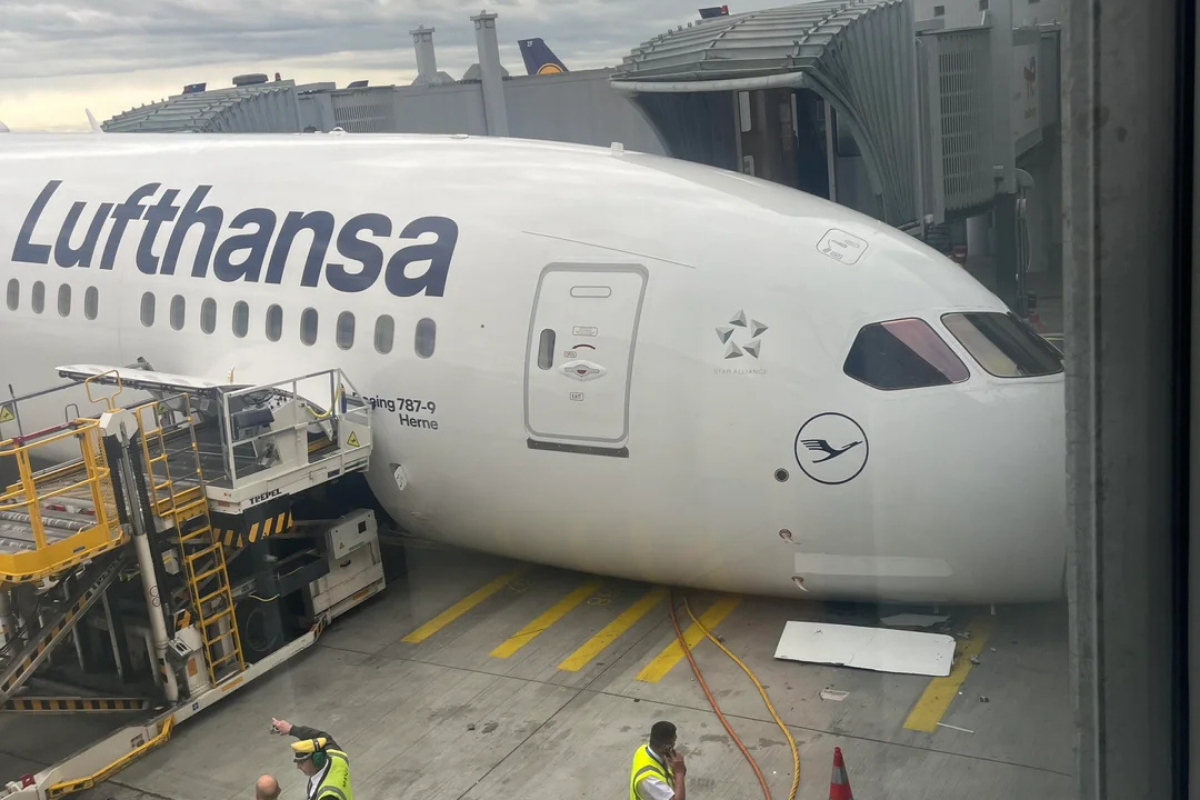
The aircraft was parked at a gate on June 4, 2026, while being prepared to operate Lufthansa Flight LH450 from Frankfurt to Los Angeles. Passengers had not yet boarded, but flight crew and ground employees were inside or working around the aircraft when its nose landing gear unexpectedly retracted.
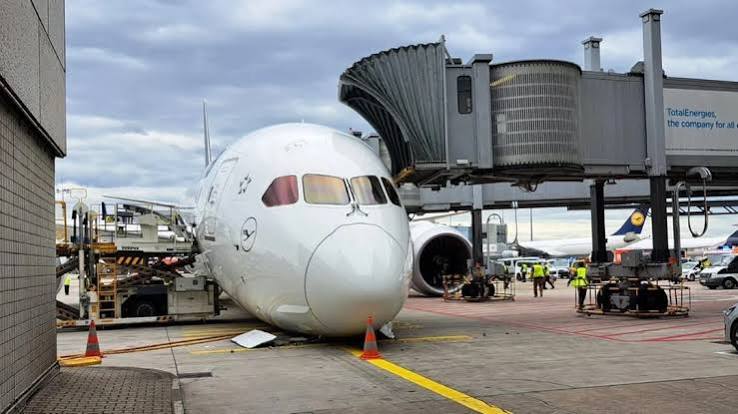
The front of the Dreamliner dropped sharply toward the ground, leaving the aircraft resting partially on its forward fuselage and triggering a large emergency response at the airport. Lufthansa said several employees required medical treatment following the incident.
The newly released findings are beginning to explain how a modern widebody aircraft sitting at a gate could suddenly collapse during a controlled maintenance procedure.
Video Shows the Dreamliner Suddenly Dropping Forward
Video footage from the airport appears to capture the moment the aircraft’s nose landing gear retracted. The forward section of the Boeing 787 can be seen dropping abruptly while the main landing gear remains extended.
The Nose-Gear Safety Pin Was Not Installed
Germany’s Federal Bureau of Aircraft Accident Investigation, known as the BFU, found that technicians were carrying out maintenance connected to the aircraft’s landing-gear door control system.
As part of that work, the landing gear was being cycled—commanded to retract and extend—to test whether the system was operating correctly.
During this type of maintenance procedure, physical locking pins are installed to prevent the landing gear from retracting. This allows technicians to test the aircraft’s systems without permitting the landing gear to fold beneath the airplane.
Investigators found that the locking pins associated with the main landing gear had been installed. However, the required downlock pin for the nose landing gear was not in its designated position.
The nose-gear locking pin was reportedly later found inside its storage box in the aircraft’s forward compartment.
Without the pin physically securing the nose gear’s locking mechanism, the nose landing gear was able to retract when the maintenance test was performed.
The preliminary findings establish what investigators discovered during the initial examination, but they do not yet assign final responsibility or determine the full probable cause of the incident.
Investigators will still need to examine the maintenance procedure, communication between workers, checklist compliance, supervision and the circumstances that allowed the test to begin without the nose-gear pin installed.
Employees Were Still Aboard the Aircraft
The timing of the collapse made the incident particularly serious.
Although passengers had not yet boarded, Lufthansa confirmed that crew members and ground employees were aboard or working around the Dreamliner. Several employees were injured and received medical treatment.
The aircraft had been scheduled to depart for Los Angeles shortly afterward, but the flight was cancelled.
Images from Frankfurt showed the large widebody aircraft tipped forward at the gate, with emergency vehicles surrounding it. The impact also caused substantial damage around the aircraft’s forward lower section.
The Boeing 787 involved was one of the newer aircraft in Lufthansa’s long-haul fleet. Boeing said after the incident that it was aware of what happened and was supporting the airline.
A Second Clip Shows the Aftermath at the Gate
A second video shows the aircraft resting forward at the gate after the collapse, with airport personnel and emergency responders working around the damaged Dreamliner.
A Similar Boeing 787 Collapse Happened at Heathrow
The Frankfurt incident has drawn comparisons with a similar Boeing 787 accident at London Heathrow Airport in June 2021.
In that case, a British Airways Boeing 787-8 was also undergoing a maintenance procedure that involved cycling the landing gear while the aircraft was parked.
Investigators later found that a locking pin intended to prevent the nose landing gear from retracting had been inserted into an adjacent hole rather than the correct locking position.
Because the two positions appeared similar, the pin did not secure the gear as intended. When the retraction command was issued, the nose landing gear folded and the aircraft dropped forward.
Changes were subsequently introduced to reduce the possibility of the pin being placed in the wrong location.
The preliminary information from Frankfurt points to a different immediate circumstance. Investigators reportedly found that the Lufthansa aircraft’s nose-gear pin had not been installed and remained in its storage box.
However, both incidents raise a similar underlying concern: how a safety-critical maintenance test was allowed to proceed without positive confirmation that the nose landing gear had been physically secured.
Why the Investigation Is Not Finished
The presence of the pin in its storage box does not, by itself, answer every question surrounding the accident.
Investigators will likely examine who was responsible for installing and verifying the locking pins, whether the maintenance checklist required independent confirmation, how the work was coordinated and whether any procedural or organizational weaknesses contributed to the collapse.
They will also assess the aircraft’s damage and review maintenance records, aircraft system data and statements from the workers involved.
A final BFU report could take months to complete. That report may determine the probable cause and issue safety recommendations intended to prevent another aircraft from collapsing during similar maintenance work.
For now, the preliminary findings indicate that the Dreamliner’s nose gear did not simply fail without warning. It retracted during a controlled maintenance test while the physical safety device intended to prevent that movement was not installed.
That finding turns the incident from an unexplained landing-gear collapse into a wider examination of maintenance procedures, checklist discipline and the safeguards designed to protect aircraft and the people working aboard them.
The investigation remains ongoing. Preliminary findings may change as investigators collect additional evidence, and a final determination of the cause has not yet been released.