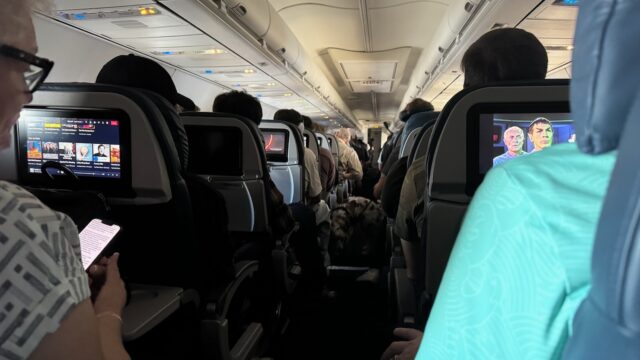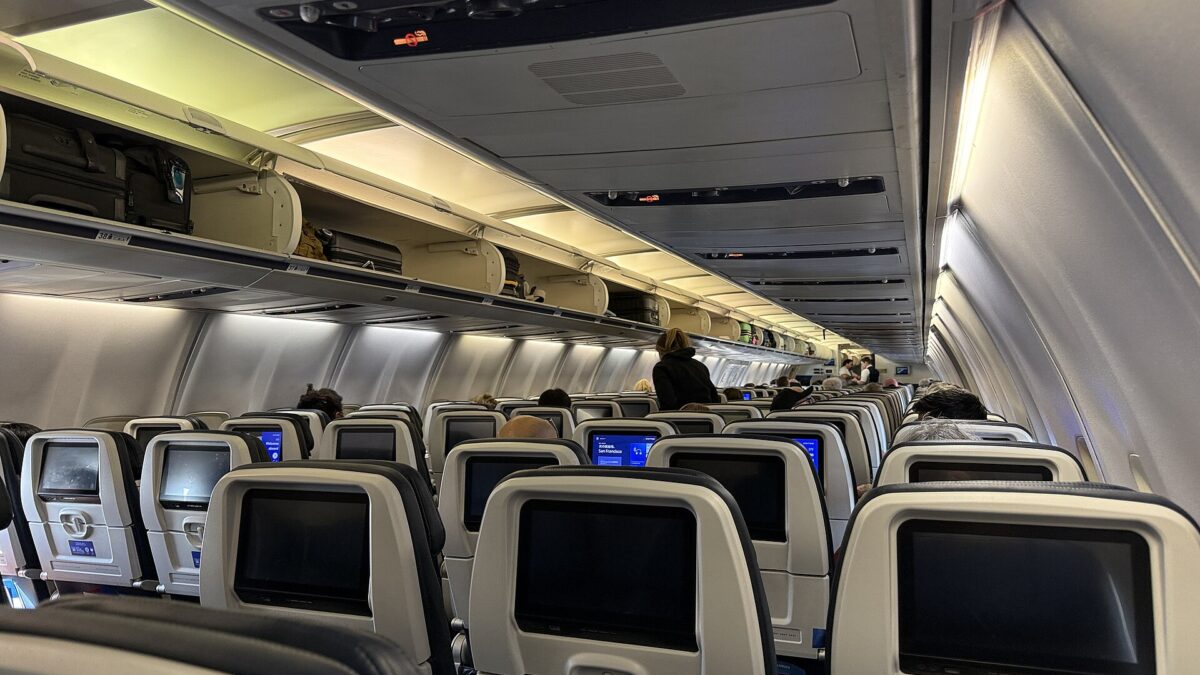
United Airlines must continue defending a proposed class-action lawsuit brought by passengers who say they paid for “window seats” that were positioned beside solid cabin walls.
U.S. District Judge James Donato denied United’s motion to dismiss on July 6, allowing claims for breach of contract, breach of implied contract and promissory estoppel to move forward in the Northern District of California.
The ruling does not establish that United misled passengers or owes damages. It means the plaintiffs alleged enough facts for the case to proceed beyond the pleading stage.
What the passengers allege
The case, Brenman et al. v. United Airlines, Inc., centers on aircraft rows where the cabin layout places a seat against the fuselage but no exterior window is aligned with it.
According to the amended complaint, United’s booking page identified some of those positions as window seats, and boarding passes also used the window-seat label. The passengers allege that they paid higher seat-selection fees without being told that the seat would be next to a blank wall.
Window alignment varies by aircraft because cabin rows, structural frames, ducts and emergency-exit arrangements do not always line up neatly. The lawsuit does not claim that windowless wall seats are inherently improper. The dispute is about how those seats were described and sold.
United’s argument—and why dismissal was denied
United argued that the word “window” described a seat’s location relative to the aisle, not a promise that an exterior window or view would be present. It also argued that the passengers’ claims were preempted by the federal Airline Deregulation Act.
Judge Donato rejected both arguments as grounds for ending the case at this stage.
The court noted that United’s Contract of Carriage incorporates terms printed on or in a ticket. The plaintiffs alleged that reservation screens represented at the time of booking that United would provide a window seat, while boarding passes expressly stated that a window seat had been purchased.
Those allegations plausibly supported the claim that United agreed to provide a seat with a window, the judge concluded. Whether “window seat” ultimately means a literal window or merely a position beside the cabin wall raises a factual issue that cannot be resolved solely from the complaint on a motion to dismiss.
Why federal airline law did not end the case
The Airline Deregulation Act generally prevents states from imposing rules related to an airline’s prices, routes or services. United argued that this federal preemption barred the state-law claims.
The court distinguished government-imposed regulation from an airline’s own voluntary contractual obligations. Claims seeking to enforce promises the airline allegedly made to its customers are not automatically preempted, Judge Donato wrote.
Because the passengers’ claims arise from United’s alleged contracts and representations, the court found that federal preemption did not block them.
What the ruling does—and does not—decide
- The case survives: United’s motion to dismiss was denied.
- No liability finding: the court has not decided whether United breached a contract or misled anyone.
- No class has been certified: the lawsuit is proposed as a class action, but certification is a separate legal step.
- No damages have been awarded: the amount and availability of any recovery remain unresolved.
The next stages may include evidence gathering, disputes over class certification, additional motions or settlement discussions. United can still contest the facts, the meaning of its booking language and whether individual passengers suffered recoverable losses.
United has added clearer seat information
United said it updated its website and mobile application in 2025 to provide more information during seat selection, including disclosures for certain positions without a window.
That change does not determine whether the airline’s earlier descriptions created contractual obligations. It does, however, show the practical value of explicit seat-map warnings.
Other airlines and third-party seat maps sometimes label a position as “missing a window,” “misaligned window” or “limited view.” Clear disclosure lets travelers make an informed choice, particularly when a seat carries an additional fee.
Why a window can matter to passengers
An outside view is not merely aesthetic for every traveler. Some passengers use the horizon to manage motion sickness or anxiety. Others select the window for photography, privacy or the ability to rest against the cabin wall.
The legal question is not whether every passenger values a view equally. It is whether United’s words and booking process reasonably promised a feature for which the plaintiffs say they paid.
The court has now decided that question deserves further factual development. The ultimate outcome will depend on the evidence and later rulings—not on the denial of this initial dismissal request.