
Three major U.S. airlines recently displayed the exact same $523 fare for trips between Chicago and Denver, a match precise enough to revive an old question: are airline prices truly competitive, or are carriers moving in lockstep?
The screenshot that sparked the debate showed American Airlines and United Airlines departing Chicago O’Hare, while Southwest Airlines served the same city pair from Midway. Despite the different airports, schedules and products, the headline price was identical.
That looks suspicious at first glance. But identical fares are not, by themselves, proof of price-fixing. The more revealing story is how modern airline pricing works—and how quickly carriers can see and respond to one another.
Why the same fare can appear across several airlines
Airlines do not price every seat from scratch each time a traveler searches. They maintain fare “menus” made up of booking classes, rules and price points. Revenue-management systems then decide which fare classes remain available on each flight based on demand, remaining seats, time before departure and expected future bookings.
ATPCO, the industry’s long-standing fare-distribution platform, helps carriers publish and distribute fares and their rules. It does not set an airline’s price or decide how many seats are offered at a given price. Airlines also monitor public shopping results, reservation systems and competitive-pricing data, so a rival’s fare change can become visible very quickly.
That transparency creates a powerful incentive to match. An airline that cuts a fare by one dollar might briefly rise to the top of a price-sorted search, but competitors can respond almost immediately. Meanwhile, travelers often choose by schedule, airport, nonstop availability, loyalty benefits or onboard product—not simply by the lowest dollar.
The “half the time” statistic needs context
A widely cited Yale research paper helps explain why the $523 match is not necessarily an isolated event. Researchers Jose M. Betancourt, Ali Hortaçsu, Aniko Öry and Kevin R. Williams analyzed daily prices and bookings for competing U.S. airlines across 50 routes, using nine months of 2019 departures.
In markets where each of two airlines offered exactly one flight, the researchers found that prices across carriers were nearly equal 50% of the time. They attributed that pattern to airlines having identical prices in their fare menus. The study also observed that managers responsible for those menus monitor competitors and may match their fare structures, even when the flight-level pricing algorithm itself does not directly use a rival’s price.
That is an important distinction: the study covered a specific sample of two-carrier routes, not every airline market, and it did not conclude that half of all U.S. fares are illegally coordinated.
Matching prices is not automatically price-fixing
The Federal Trade Commission says companies may independently match a competitor’s publicly available price. The legal line is crossed when competitors agree or coordinate on a common pricing plan.
For consumers, the visual result can look the same either way: several sellers posting an identical number. The difference is the evidence behind it. Parallel pricing may reflect public information, similar costs, common demand signals and rapid competitive responses. A price-fixing case requires evidence of an agreement or coordinated conduct—not merely matching numbers on a search screen.
Why ATPCO still attracts scrutiny
The concern is not imaginary. In the early 1990s, the U.S. Department of Justice brought an antitrust case involving major airlines and the fare-information system then known as ATP. The department alleged that carriers used future effective dates and other fare-filing features to signal intentions, negotiate increases and remove discounts across routes.
A 1994 settlement allowed the industry to keep using the system for legitimate fare distribution but restricted features that enabled airlines to communicate future pricing intentions. That history explains why identical fares—and the technology that circulates them—still draw close attention.
What travelers should do
- Compare airports as well as airlines. Chicago O’Hare and Midway can produce very different total trip costs once ground transportation is included.
- Check the full price. Bags, seat selection, changes and boarding benefits can make an apparently identical base fare a very different deal.
- Use flexible-date tools. Nearby departure times or dates may open a lower booking class even when the headline options match.
- Recheck before buying. Airline inventory changes continuously, and a lower fare bucket can appear or disappear without the published fare menu changing.
The bottom line
The $523 Chicago–Denver match is striking, and consumers are right to question a market where rivals can observe and answer one another almost instantly. But the screenshot alone does not establish that American, United and Southwest “rigged” the fare.
What it does reveal is a highly transparent, tightly watched pricing system in which airlines often work from similar fare menus, adjust seat availability dynamically and know when competitors move. That can make independent pricing look remarkably coordinated—even down to the dollar.
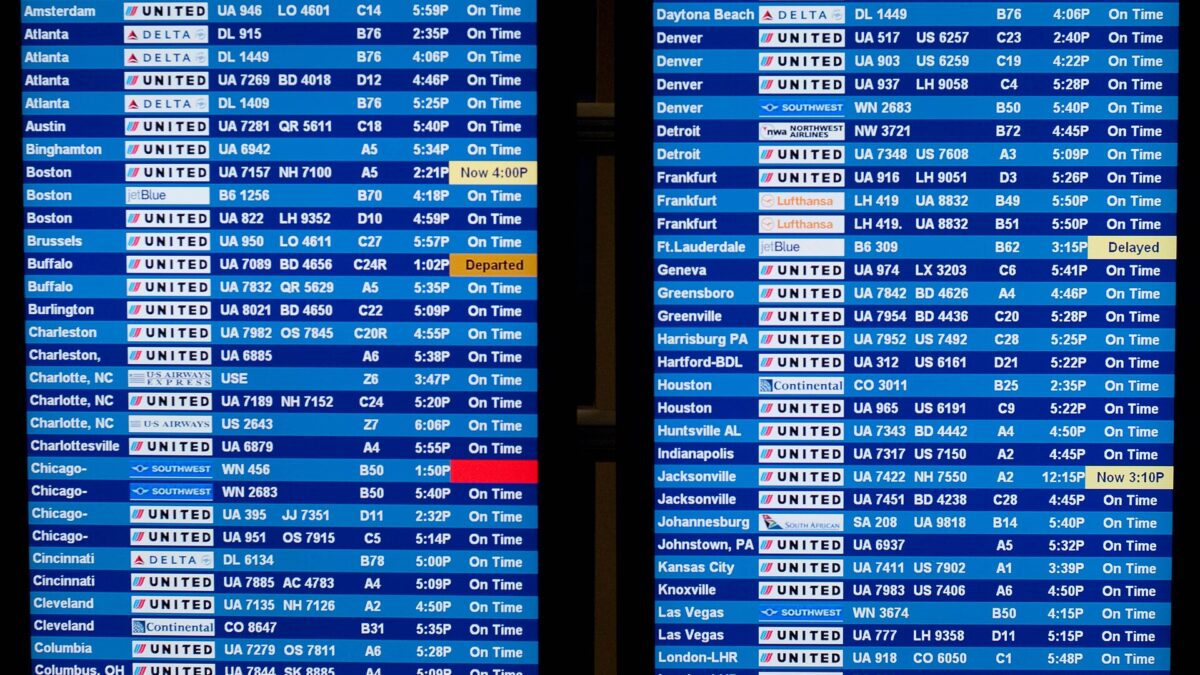
Featured image: Departure and arrival board at Washington Dulles International Airport. Photo by paul_houle, via Wikimedia Commons, licensed under CC BY-SA 2.0.
.jpg)