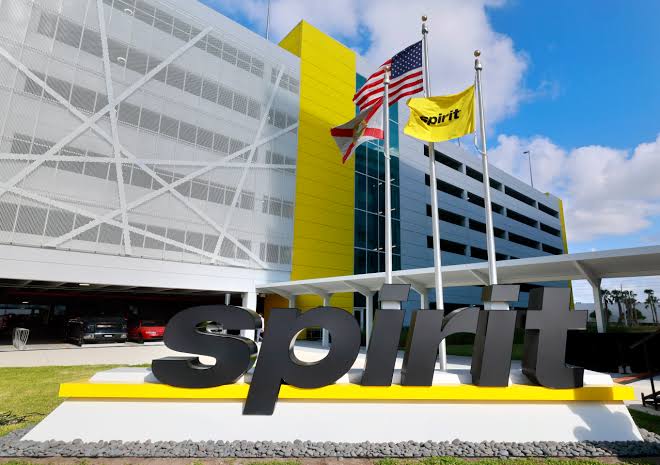
Spirit Airlines’ brand-new corporate campus in Dania Beach, Florida, was supposed to represent the airline’s next chapter. Instead, it has become one of the clearest symbols of how fast the carrier’s financial story fell apart.
Spirit Central officially opened in April 2024 near Fort Lauderdale-Hollywood International Airport. At the time, Spirit described the campus as an 11-acre headquarters with training facilities, employee housing, and modern spaces for its team members.

But according to View From The Wing, the same campus that Spirit originally announced as an investment of up to $250 million now has a stalking-horse bankruptcy bidder offering just $88 million in cash.
The bidder is reportedly an affiliate of Boston investment firm Hill City Capital. If no higher offer appears, that bidder would acquire the campus assets at a price equal to only about 35% of the project’s originally advertised cost.
The contrast is striking. Spirit built the campus during a period when the airline was trying to reinvent itself, recover from financial pressure, and move beyond its old ultra-low-cost image. But the company’s costs were rising, its business model was weakening, and the airline later entered a much deeper collapse.
Spirit Central is officially open in sunny Dania Beach, FL! 🌴
Our new corporate campus spans 11 acres with top-notch facilities for our amazing Spirit Team Members. From a cutting-edge training facility to dedicated housing, it's all here. The best part is it's super close to… pic.twitter.com/db6LaKvede
— Spirit Airlines (@SpiritAirlines) April 18, 2024
Advertisement
The bankruptcy docket details show why the property is unusual. The campus includes a six-story corporate office building of about 180,000 square feet, designed for more than 1,000 employees. It also includes a roughly 108,000-square-foot training center with eight full-flight simulator bays, classrooms, and cabin-training equipment.
There is also a “Fueling Station” of about 13,000 square feet with food, lounge, coffee, and fitness facilities, plus “The Landing,” a residential component with 200 two-bedroom corporate apartments designed to house up to 400 visiting employees.

The property also includes 998 garage parking spaces, 125 surface spaces, and a development site marketed as capable of supporting another building of roughly 180,000 square feet.
However, the sale is not as simple as buying a normal headquarters building. View From The Wing reported that the flight simulators are not included in the sale, and that the residential building sits on a long-term ground lease rather than owned land.
That helps explain why the bankruptcy valuation is so much lower than the original project cost. A specialized airline campus can be expensive to build, but difficult to sell at full value when the original airline no longer needs it.
Spirit’s collapse also changed the meaning of the campus. What once looked like a confidence signal now looks like a costly bet made at the wrong time. The airline was trying to modernize and stabilize, but its core low-cost advantage had already weakened.
In May 2026, Spirit announced an orderly wind-down of operations, saying all flights were canceled and passengers should not go to the airport. The company cited rising fuel prices, financial pressure, and the lack of additional funding as reasons it could no longer continue operating.

The court-approved bidding procedures give the stalking-horse bidder certain protections. If another buyer wins, the original bidder may receive a 3% breakup fee, equal to $2.64 million, plus up to $500,000 in documented expenses.
Competing bids for substantially the same assets must beat the $88 million offer by enough to cover those protections plus an additional 2% of the stalking-horse price. View From The Wing calculated that the opening threshold would be about $92.9 million if the full expense reimbursement is included.
The sale is expected to be considered at a bankruptcy hearing on September 16, 2026. Until then, another bidder could still emerge with a higher or better offer.
For aviation watchers, the bigger story is not only the real estate. It is what the campus says about Spirit’s final years. The airline that built its name on bare-bones costs ended up with a large, specialized headquarters just before its business model failed.
That is why the $88 million figure is so attention-grabbing. Spirit Central was built as a headquarters for the future. Now, barely two years after opening, it is being priced as a distressed bankruptcy asset.
For employees, travelers, and creditors, the campus sale is another reminder of how quickly an airline can go from expansion plans to liquidation. Spirit Central may still find a new owner and a new use, but it will no longer represent the airline future Spirit once promised.