
Europe entered the summer travel peak with the thinnest jet-fuel buffer of any major market: roughly 38 million barrels in storage, equal to less than 30 days of demand. The number is alarming, but it is not a countdown to the day Europe’s airports run dry.
Fuel inventories are only one part of a constantly moving supply system. Refineries keep producing, tankers keep arriving and airlines secure fuel through contracts and daily coordination with suppliers. Europe’s problem is that it has less room for disruption if Middle Eastern tensions again restrict the routes and refineries that feed the market.
What “less than 30 days” actually means
Energy Aspects data cited by Reuters placed European jet-fuel inventories at about 38 million barrels at the start of June. The United States held approximately 99 million barrels. When the European stockpile is divided by expected daily demand, it provides less than 30 days of cover—the tightest balance among the major jet-fuel markets.
That measurement describes resilience, not a fixed expiration date. Europe does not normally stop importing or producing fuel while it draws down inventory. New cargoes arrive continuously, and refiners adjust output in response to demand and price.
The risk is that a major supply interruption could consume the available cushion before replacement cargoes arrive. In a comfortable market, buyers have time to reroute tankers, increase refining or source fuel from another region. With a thinner buffer, any delay has a faster effect on prices and airport-level availability.
Why Europe is more exposed than the United States or Asia
Decades of refinery closures have made Europe more dependent on imported jet fuel, particularly in Britain, France and Germany. Before the latest Middle East conflict, the region sourced around half of its jet-fuel imports from the Middle East.
The Strait of Hormuz is central to that trade. It normally carries roughly one-fifth of the world’s seaborne oil and liquefied natural gas, so renewed fighting or slower vessel traffic can quickly affect insurance, shipping schedules and the price of replacement cargoes.
Energy Aspects projected a European jet-fuel supply deficit of nearly 600,000 barrels per day in the third quarter. By comparison, its outlook showed surpluses in the United States and Asia-Pacific, highlighting the regional imbalance rather than a worldwide shortage.
Europe is already replacing disrupted supplies
The strongest reason not to interpret the inventory figure as an immediate grounding threat is the scale of the response already underway.
Europe imported about 673,000 barrels per day of jet fuel in June, according to Kpler data reported by Reuters—the highest monthly rate since October 2025. The United States and Nigeria were the largest suppliers, while Canada, India, Kuwait and South Korea also contributed cargoes.
European refiners have increased production, and the latest International Energy Agency figures cited by Reuters showed jet-fuel stocks at the end of May were provisionally 10% higher than a year earlier while refinery output had risen 30%.
Those flows do not eliminate the vulnerability. They show that the market is adapting by changing suppliers, increasing output and drawing from inventory at the same time.
The immediate pressure is financial
Jet fuel is normally one of an airline’s largest operating expenses, often accounting for 20% to 25% of total costs. A thin supply buffer increases price volatility because airlines and fuel traders compete for replacement cargoes and pay more for shipping, insurance and short-notice delivery.
IATA’s Jet Fuel Price Monitor reported a global average of $127.06 per barrel for the latest week, up 6.7% from the previous week. In northwest Europe, Reuters reported that prices had eased to about $133.27 per barrel after reaching a record $215.32 at the end of March.
That decline matters: the market remains expensive and exposed, but it is no longer at its peak. Airlines may still respond by trimming marginal flights, protecting fuel for stronger routes, adding surcharges or revising earnings guidance. Immediate fare discounts are unlikely because passenger demand remains strong and available capacity is already constrained.
What governments and airlines can do
- Coordinate reserve releases. The European Commission has said Brussels could help organize releases from national reserves if conditions deteriorate.
- Diversify imports. Cargoes from North America, West Africa and Asia reduce dependence on any single route or supplier.
- Increase refinery output. European refiners can shift their product mix toward jet fuel when economics and equipment allow.
- Adjust schedules. Airlines can reduce weaker frequencies, consolidate passengers onto fuller aircraft and protect strategically important long-haul services.
- Use operational fuel planning. Carriers can coordinate closely with suppliers and, where practical, carry additional fuel from airports with stronger availability.
What passengers should watch
Travelers are more likely to notice higher fares, fuel surcharges or selective schedule reductions than widespread airport shutdowns. The most exposed routes would be services with weak demand, high fuel burn or limited strategic value—not necessarily every flight from the countries with the lowest inventories.
The situation could worsen quickly if shipping through Hormuz is restricted again, refineries suffer outages or replacement cargoes are delayed. It could also stabilize if the truce holds, imports remain elevated and European production continues to rise.
The bottom line
Europe’s sub-30-day jet-fuel cover is a serious warning that the region has little margin for another disruption. It is not evidence that aircraft will stop flying when a calendar reaches day 30.
The more immediate threat is economic: volatile fuel prices, pressure on airline margins and less tolerance for unprofitable flying. Europe has kept the system supplied by importing record volumes from a broader group of sellers. Whether that continues through the late-summer peak will determine if the crisis remains a costly logistics challenge or becomes an operational one.
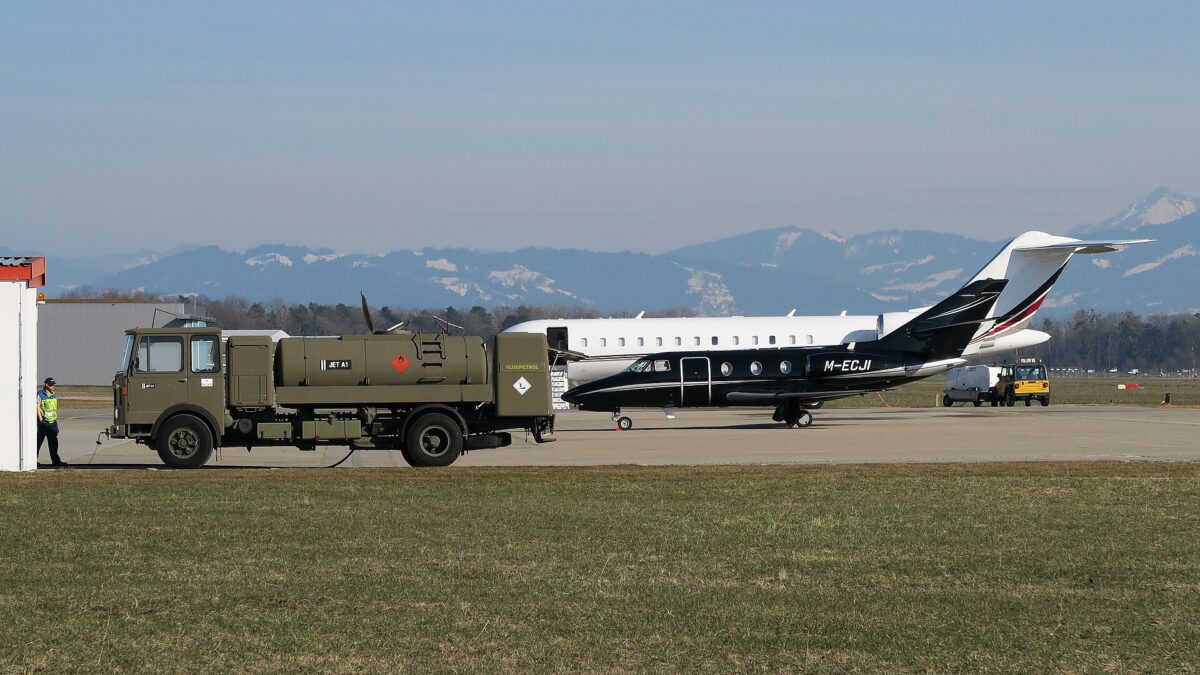
Featured image: Aircraft and a jet-fuel tanker at St. Gallen-Altenrhein Airport in Switzerland. Photo by Kecko, via Wikimedia Commons, licensed under CC BY 2.0.
Comments 0
No comments yet. Be the first to share your take.


.jpg)