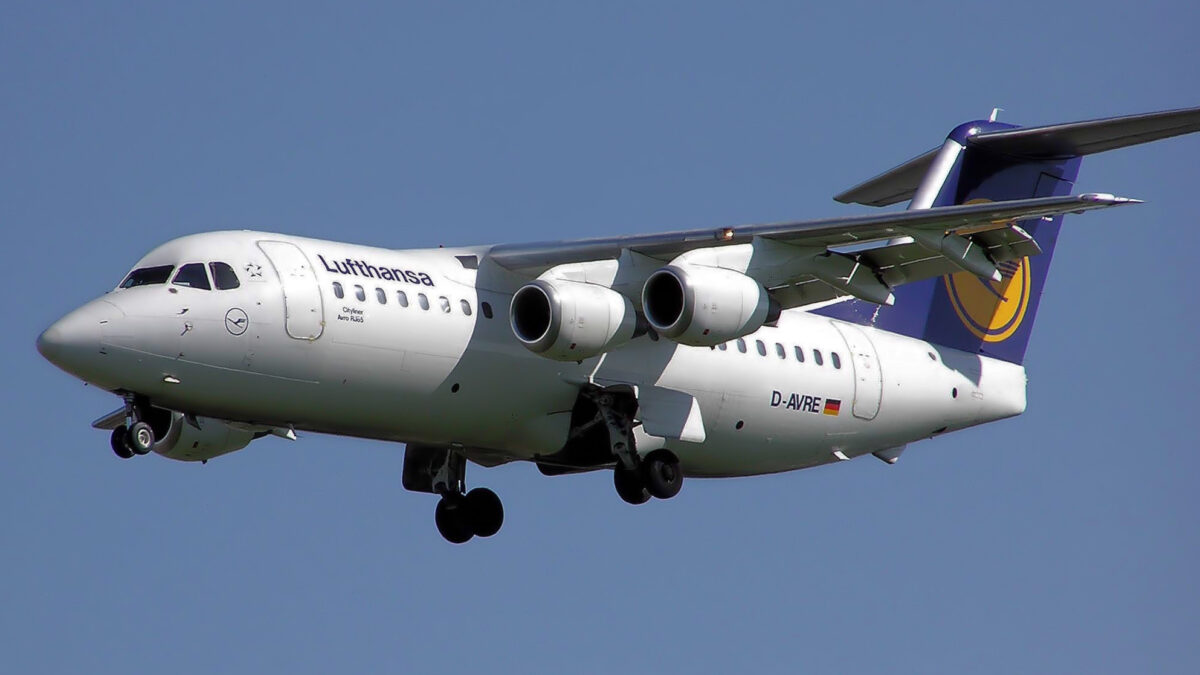
The British Aerospace BAe 146 remains one of the most unusual regional jets ever built, largely because of one design choice that still stands out today: it had four engines despite being a relatively small short-haul aircraft.
At first glance, that layout seems excessive. Most modern regional jets of similar size use two engines, which are usually cheaper to maintain and more fuel-efficient. But when the BAe 146 was being developed, British Aerospace was not simply trying to build another small jet. It was trying to create a quiet, city-airport-friendly aircraft that could operate from short runways and challenging airfields.
The aircraft, later developed into the Avro RJ family, used a high-wing design, a T-tail, and four geared turbofan engines mounted under the wings. The type became known for its quiet operation and was marketed as the “Whisperjet,” a key advantage for airports with strict noise limits and urban surroundings.
The four-engine layout was closely tied to the engines available at the time. The Lycoming ALF 502 turbofan was quiet and suitable for the aircraft’s mission, but each engine did not produce enough thrust for the BAe 146’s required performance if only two were used. By installing four smaller engines, the aircraft could achieve the power it needed while keeping the noise level low.
That setup also gave the BAe 146 strong short-field performance. The aircraft was designed for regional and city-based routes where runway length, approach angle, and airport noise restrictions could be serious limitations. Four engines helped provide better takeoff performance, especially from short runways or airports in hot, high, or more demanding operating conditions.
Another advantage was redundancy. With four engines, the aircraft could lose one engine and still have three operating, which gave it a safety and performance margin that was attractive for certain operators. This was especially useful for routes involving mountainous terrain, smaller airports, or less forgiving operating environments.
The BAe 146 also used a large rear airbrake and full-width wing spoilers instead of traditional thrust reversers. This helped the aircraft descend steeply and slow down effectively after landing, making it more practical for airports where approach and runway performance mattered.
However, the same design that made the aircraft special also became one of its long-term weaknesses. Four engines meant more maintenance work, more parts, and higher operating costs compared with later twin-engine regional jets. As engine technology improved and modern twinjets became quieter, more powerful, and more efficient, the BAe 146’s four-engine layout became harder to justify economically.
Still, the BAe 146 was not a mistake. It was a product of its time, designed around a very specific mission: quiet regional jet service into airports where many other jets were too loud, too fast, or needed too much runway. Its four engines were unusual, but they helped give the aircraft the performance and personality that made it one of Britain’s most recognizable regional airliners.
Comments 0
No comments yet. Be the first to share your take.