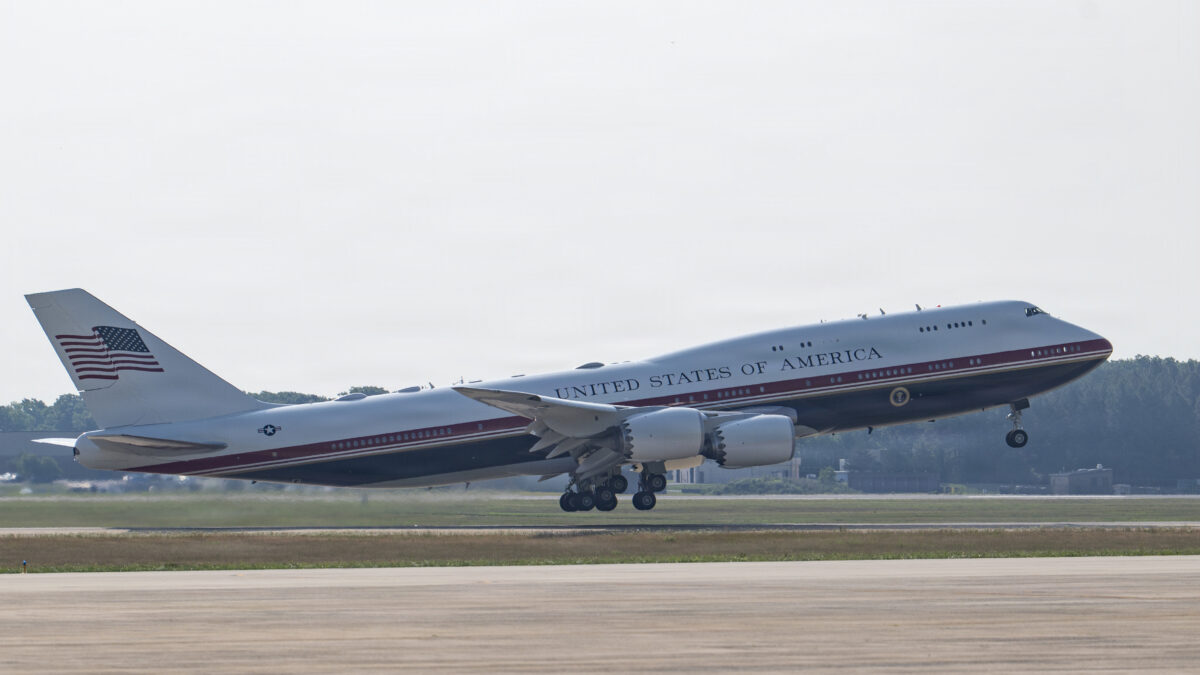
President Donald Trump’s newly converted “bridge” Air Force One has entered the international spotlight, with the aircraft being used for a high-profile trip to Turkey as the United States attends the NATO summit in Ankara.
The aircraft, a Boeing 747-8 originally linked to Qatar, has drawn attention because of both its luxury design and its unusual role in the presidential fleet. It is intended to serve as a temporary bridge aircraft while the long-delayed next-generation Air Force One jets continue through development.
The jet has been valued at around $400 million and has been repainted in a red, white, navy, and gold color scheme preferred by Trump. The aircraft replaces the traditional light-blue Air Force One look with a darker and more dramatic exterior, while the cabin reportedly keeps much of its luxury head-of-state layout.
The aircraft made its public debut on a domestic presidential trip to North Dakota before being prepared for wider use. Reports said Trump planned to use the jet for the NATO summit in Turkey, making the aircraft’s move into international service one of its most closely watched early missions.
Advertisement
Its role is important because the current VC-25A aircraft, the familiar Boeing 747-based Air Force One jets, have been in service for decades. Two new Boeing VC-25B aircraft are still expected to replace them, but delivery delays have pushed the program back, leaving the administration to rely on the bridge aircraft in the meantime.
The new jet has also generated controversy. Because the aircraft came from Qatar, critics have raised ethical and national-security questions over the acceptance and conversion of a foreign-linked aircraft for presidential use. U.S. officials have said the aircraft was inspected and modified for presidential transport, while also acknowledging that some complex changes planned for the final Air Force One replacement aircraft were not included in the bridge version.
That has made the aircraft a symbol of both modernization and debate. Supporters see it as a faster way to give the president a newer and more visually prominent aircraft, while critics argue that presidential airlift should avoid even the appearance of foreign influence or reduced security capability.
For aviation watchers, the Turkey mission marks a major step in the aircraft’s operational story. It is no longer just a converted luxury 747 shown off at Joint Base Andrews or used on a domestic flight. It is now being tested on the international stage, carrying the weight of diplomacy, security, politics, and one of the most recognizable call signs in the world.
Comments 0
No comments yet. Be the first to share your take.